Showing posts with label nigeria. Show all posts

Tuesday, January 06, 2009

Elechi Amadi kidnapped in Niger Delta


I have just found out via the Jos-ANA listserve that Nigerian novelist, playwright, and poet Elechi Amadi, probably most known for his novel The Concubine and prison diary Sunset in Biafra, was kidnapped by militants in the Niger Delta. The only article I have been able to find about it so far is on Bloomberg News

For more information about Elechi Amadi, see his website. (Note: the website does not yet have mention of the kidnapping).


Update 8:52pm: And after my dinner break, I came back to find the news also on BBC.

And a very short piece on Afrique en ligne in English and French. Apparently Amadi is also the chairman of the Rivers State scholarship board.
Update 10:36pm: A friend just im-ed me and let me know that according to elechiamadi.org, he has been released. It has not yet shown up on google news alerts; but here is a link to the discussion post in which one degini2 says that he has been "returned to his home."
Image Credit: Sun News Online


Monday, December 29, 2008

Yonder breaks the new and glorious morn

I must admit I have recently been worried about what I can post on this blog. I am discovering more and more people who are following it (either the occasional drop-in or the avid “follower” who I assume gets an email when I make a new post), all of them from very different backgrounds. They say write for your audience, but I’ve got a funny audience. I’ve got Nigerians from the South and Nigerians from the North. I’ve got Americans and a few Europeans. I’ve got academics. I’ve got atheists and agnostics. I’ve got Buddhists. I’ve got Muslims and evangelical Christians, Catholics, Pentecostals. Politically conservative and politically radical. I’ve got people I’ve known since high school, and people I’ve never met except through their comments on my blog. So when I “write what I’m thinking” (the meaning of the title of this blog in Hausa) how careful do I need to be? Can I just write what I want or do I need to issue disclaimers on everything?

I remember the advice of an old poetry professor who said you can’t think about what your family (or others) will think when you write, you just have to write what is true to yourself. But as an academic, I also have a little critic crouched on my shoulder, repeating back to me what my various readers might say to themselves. I worry about the ethics of being “true to myself” when it involves writing about other people or even writing about what I’m thinking. I can’t write as freely as I could if I were writing poetry, which has a certain limited audience, and in the age of internet these posts are far more accessible than my poems ever would have been.

Maybe I should start giving Victorian-type titles or chapter descriptions, and people can choose whether to read it or not.

This one will be:

“A Very Long and Personal Post In which Talatu-Carmen Worries about her Audience and then Muses about the Original Christmas and Christianity in Relation to the Jos Crisis.”

“O Holy Night”

I have been thinking during this Christmas season about refugees and displaced people, poverty and war, about indigenes and settlers and politics. About how many similarities there are between the nativity story and about life here now. Christmas carols leap to life: the darkness of the earth and the sudden burst of joy, the supernatural promise of peace and how “tidings of great joy” were brought to the wretched of the earth—shepherds, peasants, a poor carpenter and his young bride who were moved by imperial decree back to their place of “origin.”

Bethlehem, Nazareth, Jerusalem, outposts in an imperial province. Arrogant Roman soldiers patrolling the streets. Rebels in the hills. The corrupt incestuous Herod family who assassinated each other and who would order the death of children to secure a political post.

In the village of Nazareth there is a young girl promised in marriage. In a Judean town there is the barren wife of a priest. Suddenly the virgin and the old woman are impossibly filled with life.

The rhythm quickens.

A carpenter is heart broken by what seems to be the girl’s betrayal. The old woman believes her, knows, when her own child leaps within her, the mysterious burden her young cousin is carrying before she says a word. Angels come down in dreams. The carpenter believes.

The rhythm quickens.

There is an imperial degree that “settlers” should go back to their place of origin to be counted. A government census is declared. Villagers mutter about the government exercise being a good excuse for officials to take extra kickbacks. What choice do they have? What control do they have over their lives? The carpenter sets off on foot with his tough pregnant little bride for the hundred mile journey. It has been long since his parents or his grandparents had left Bethlehem. There are no family, no friends that they know well enough to stay with. The town is chock full of lost, short tempered pilgrims back in what Rome calls their homeland, and there is no room for hire in the inn. The carpenter and this pregnant teenager must settle for someone’s charity, a room in a poor man’s house where the animals wander in and out, or a stable near the fields.

This is not how most women give birth for the first time. This is not how it is supposed to happen. Mary had seen her cousins give birth, with family around them, sisters and mothers and neighborhood midwives. In Nazareth there would have been clean, soft newly sewn cloths to wrap the baby in. But here she is like a refugee, in a strange town. The only familiar person is this man her parents arranged for her to marry, this man she has only just begun to know. This place they have settled is dirty. Goats and sheep and chickens wander in and out. She does not know where women go to bathe or ease themselves. She is not sure where to find water to wash her clothes. Joseph is an “indigene” of this place, but he knows no one. She had never been in this small dusty village before, although both of their ancestors were buried here.

They are dark days, brutal soldiers, corrupt tax collectors, armed robbers plaguing travelers on the roads. People are suspicious of each other. Rumours fly faster than imperial messengers bringing declarations of new taxes. The Judeans hate the Samaritans and the Samaritans hate the Judeans. The king is a despised Edomite placed in power by colonial overlords. He builds a palace on a distant rock and neglects security and the repair of roads. Religious leaders proclaim their righteousness in the streets, making great displays of their money, while their own parents starve.

The contractions come closer and closer together.

Yet there is this mystery, this insane promise made by angels that makes the tired dirty young couple glow and wonder.

This is the transcendent mystery of Christmas.

The moment of the birth when the earth exploded and all the laws of nature spun topsy turvy.

We Christians believe that God himself was born that cold dusty night in Bethlehem. That God himself burst into the world in the poorest of conditions, to tired displaced peasants who could not even comfort themselves with the warmth of home or family. It is incomprehensible to us—how such a thing could happen. Incarnation--the depth of humility in which the Creator of the Universe sank to emerge into his own creation—as if the author of a book suddenly entered its flat pages or an embroiderer sewed herself into the fabric of her art. The degree of difference between the Roman emporer and the road-weary paupers suddenly becomes miniscule. All the gold and silks and great marble palaces suddenly seem cheap and gaudy compared to what the poorest of the poor saw that night in the dusty ancestral home of David.

The world began to explode around them. The earth could not contain this limitless Being. The night sky burst with light of Presence, just as 33 years later the day would grow dark with Absence.

Shepherds, with their sheep and cattle huddled around them, staggered backwards as the night sky cracked open and stars poured down and music from outside the universe spilled in through the rupture. And it was they, a teenage girl and the manual labourer who married her, shepherds with handwoven hats and cracked heels who first felt the joy. It rippled out from there, an old man and an old woman in the temple who had waited their whole lives to see the prophecy fulfilled, foreign scholars from the East who came on camels bearing gifts for a king, the peasants of Egypt who watched the child as he grew long and slim and began to walk.

And those he touched as he proceeded towards his death: religious leaders, politicians and prostitutes, tax collectors and thieves, fishermen and soldiers, the blind and the epileptic, beggars and rebels, Jews and their hated relatives the Samaritans, colonial Roman overlords, Egyptians, and visitors from the East, those who worshiped him and those who spat on him.

The light of dawn bursts out and the darkness cannot hide it.

But there is so, so much that is wrong—good ripples out and the evil bunches up into pockets of atrocity. The small dusty town of Bethlehem witnesses the birth of an impossible Child, both an indigene and settler, human and God, Creator stitched into his own creation, and the king orders the death of dozens of other children. (How hard it is for a rich man, a ruler of an earthly province, to see the kingdom of God breaking around him like a tidal wave! It is invisible to him)

He thinks he is safe now, protected, like Pharaoh, from children who would usurp him. The Great One dies only months after he thinks he has secured his throne. His son Herod takes his brother’s wife, sneaks into her teenage daughter’s room when he thinks she’s not looking. He is driven mad by nightmares of the prophet he has beheaded yet approves another to be crucified. Another son Herod is consumed by worms that came from inside of him and eat him alive.

Now two thousand years later, these Herods still scheme, unaware of the worms that are eating them alive. They pick schoolgirls off the streets, vacation in Rome with money extorted from peasants, secure bank accounts run by distant colonial lords, pay mercenaries to kill children in the street. The worms eat them. And poor beleaguered people, who keep having to leave their homes, who grow used to gun-wielding soldiers on the roads, are still dazzled with joy at the memory of the song that drifted into our world that winter’s night.

“Blessed are the poor in spirit for they shall see the kingdom of God.”

There is such darkness in the world, and yet there is this unexplained spirit, this beauty that keeps blinding us. We keep surviving. I don’t understand it. But there it is.

Long lay the world, in sin and error pining
Till he appeared and the soul felt its worth
A thrill of hope
The weary world rejoices
For yonder breaks
A new and glorious morn
Fall on your knees
O hear the angel’s voices
O night divine
O night when Christ was born


Glory to God in the highest
And on earth peace

**
“O Come, O Come Emmanuel”

I came into Jos from Kano last week in a taxi full of Hausas from Angowar Rogo. “Kuna Jos lokacin da rigima? Were you in Jos during the crisis?” I ask the two women sitting beside me, as we left Kano. “I, wallahi,” they say beginning to exchange stories of huddling in their houses with their children and other refugees. Coming into Jos, I am stricken by what I see on the road, on the north side of town—what I did not see before because I flew out of the airport in Jos South to Lagos the Wednesday after the crisis. There the blackened outline of the sprawling school for Islamic higher education and another burnt school just before we got to Farin Gada. Rows of burnt and roofless houses and shops. As we pass, I see men bowed in prayer, filling the burnt hull of a mosque. The walls are blackened and broken down on two sides yet they bow, they pray to God.

“There is so much we did not see. There is so much we did not know.” I think. “All we saw were the churches.”

Two days to Christmas, I drive with my parents through Tudan Wada, Katako Market, and Angowar Rogo, taking shortcuts to try to get home before the curfew. Whole streets of shops lie in blackened ruins. They belong to both Christians and Muslims, but the deepest devastation is in Muslim areas.

I read the 2006 Human Rights Watch report on the indigin/settler problem in Nigeria. I'm sure they are oversimplifying some things, but how had I not known that a student could not enter any university in Nigeria without an indigin certificate from somewhere—that there are thousands and thousands of Nigerians caught between here and there, between where they’ve “settled” and their supposed “homeland” where they cannot get indigene certificates either? People who can’t get into schools, can’t get government jobs, who are seen as “settlers” wherever they go? When Jos Hausas go to Kano to make movies they are seen as being “Jos people” coming to corrupt Hausa culture. When they stay in Jos, politicians tell them to go back to where they came from.

Friends (Plateau indigenes and Christians at that) explain details of the elections—how egregiously the elections seem to have been rigged in favour of “indigene” politicians preaching a gospel of protectionism.

Onward Christian Soldiers
Marching into war

One friend tells me he was out at a night spot Thursday night of the election and heard reports from people drifting in that the ANPP candidate has won by a landslide. Then somehow PDP was reported to have won. He tells me about how people on the middle class compound, where most of his neighbors have a university degree, “began to turn into animals before my eyes.” Christians who wanted to kill the few Muslim families who lived on the compound, who only days earlier they were visiting and watching videos with. Young men, his friends from childhood, who called him to come with them to kill and old Hausa man who takes care of horses. Teenage boys and girls who beat to death a Hausa boy who fell off a passing lorry.

This is what Christians have done.

In the name of Christ.

The Prince of Peace.

I begin to understand one of my friends, a Plateau indigene, who converted from Christianity to Islam because of what he saw in the church.

Yet the other stories remain. The “Hausa Muslim” boys who burned churches at 6am on Friday morning, who pulled people out of taxis as they passed on the road and cut off old women’s hands. The Christian girl living behind a nightclub who used her phone to video the mob of young men trying to beat down her door. These stories sit there beside the stories about the young Christian men who killed a fellow Christian night guard who tried to keep his Muslim employer’s property from being burned, beside the stories of young “Christian” men who began to call their friend a traitor when he wouldn’t come with them to kill.

And then there are the stories of what the soldiers did. Christian and Muslim soldiers. Mowing down the young.

Christian. Muslim.
Indigene. Settler.
Fake Soldiers.
Real Soldiers.
Guns. Machetes.
Burned church.
Burned mosque.
Markets burned three weeks before Christmas.


This is the world that Christmas comes to.

The woman at Katako Market from whom my mother bought glass and pitcher sets before the crisis. Her neighbor gives her a few plastic buckets to hang outside the blackened remains of her shop to start over again.

The old Christian Igbo woman whose irrigation pumps are burned during the crisis, who keeps her fields green when her Hausa Muslim neighbors loan her their pumps when they have finished watering their fields.

Christmas comes upon us, unexpected, while houses are still buried in rubble, and refugees whose homes were burned still camp in relatives' houses.

Today, Sunday, the Sunday after Christmas, the last Sunday before the new year, we go to the small cement block community hall where Emmanuel Baptist church is meeting while they wait to begin rebuilding their church for the third time. There are a few streamers and balloons hanging from the ceiling and letters spelling out “Happy X-mas” hung haphazardly on the walls. Women and children greet us warmly. Little girls call out “Aunty Talatu.” The children sit on the floor at the front, while adults squeeze onto benches propped up on stones.

“I’m not happy that we don’t have enough chairs” said the pastor in Hausa, waving the children to the front. He was smiling.

He and his family had gone to the wildlife park with their three children and two foster daughters a week after the crisis to give the children a vacation. While there, they were robbed at gunpoint by men who lay them on their faces and searched in their pockets and purses, said they would kill the children if they did not cooperate.

These are the people who slept on our floors and who sat outside to eat paltry bowls of badly seasoned rice for four or five days. Who had to take baths in cups of water in our bathroom without a drain.

I should not have been surprised by the joy I saw on their faces today. Two days after the crisis started when their service was held at our house, with girls dressed in jeans and mothers in mismatched wrappers, they still sang and danced. They still woke at 5am each morning to pray and sing.

Rejoice, rejoice, Emmanuel,
Shall come to thee, o Israel

Now they wore lace. Their shocked anger had given way to thanksgiving. Most families had gone back to their neighborhoods, to rebuild relationships with old neighbors.

The service is in Hausa. A man comes to the front to exhort the church to remember how Jesus said “If someone takes your cloak, do not stop him from taking your tunic.” He prayed that those whose homes had been burned would be given another. The assistant pastor, an elderly man whose house was burned, leads the singing.

After the exhortations, there are two occasions to celebrate: a baby dedication, and a thanksgiving for a couple married two days before.

The baby girl is prayed over. The drummer beats a danceable rhythm on the newly donated drums. People dance and sing and laugh, laugh, laugh.

The groom, an architect, had been married before. His wife lost their first baby in childbirth. On the road from the village where she had gone to recover, she and her sister were killed in a car accident. Now, two years later, he has married again. The bride smiles and dances as we bring up another offering. The young couple pledges to donate N5000 to help the church buy new chairs. After the service, they pass out a crate of minerals.

So many new beginnings.

See these people who keep coming back.

O come to earth
Abide with us
Our Lord, Emmanuel

The church is a bright bird, bursting out of the flames.

Reborn again and again.

Through the fire and the smoke. Through the gunfire and the raging mobs and the hungry roads and angry robbers.

***
There are those who politic in God’s name.

Those who kill in God’s name.

Those who steal in God’s name.

Those who take revenge in God’s name.

Those who demonize their neighbor in God’s name.

And you can call them Christians and Muslims if you like.

And call it a religious crisis if you like.

A holy war if you like.

If that is what you think God is like.

***
O Come thou rod of Jesse free
Thy home from Satan’s tyranny
From depths of hell thy people save
And give them victory o’er the grave
Rejoice, rejoice, Emmanuel
Shall come to thee, O Israel”
***


But this is what I saw today: Love. Joy. Peace. Patience. Kindness. Gentleness. Self Control.

Angry shock given way to joyful forgiveness.

And this is what I heard, at the end, after we had danced and sung for the bride and the groom and the child.

“May the Grace of our Lord Jesus Christ, the love of God, and the sweet fellowship of the Holy Spirit be with us now and forever more.

Surely goodness and mercy will follow us all the days of our lives, and we will dwell in the house of the Lord, forever.

The church is named Emmanuel:

God is with us.

Sunday, October 05, 2008

Most Gorgeous Nigerian Women (apparently live abroad...)


I will bracket the concern whether there should be these lists of people classified by their physical attractiveness at all (I admit I'm a sucker for People Magazine's the 50 Most Beautiful People), but let me speak to another concern. As I read through the "artville" section in today's Leadership "Most Gorgeous Nigerian Women" by Zully Abdul, I was struck by the fact that with the exception of Nollywood actresses Dakore Egbuson and Genevieve Nnaji and possibly model Agbani Darego, the women (12 out of 15) featured here live and have careers outside of Nigeria. Now of course I am in favour of celebrating the achievements (beauty, career, or otherwise) of Nigerians wherever they may reside and I am uncomfortable with "more authentic than thou" arguments; however, what does this list say about the standards used in judgment and what does this mean to the target audience, which I assuming would be women living in Nigeria where print copies of Leadership are distributed? Is it that there is a paucity of "gorgeous" women who actually live and work in this country???? I've seen women just as gorgeous if not more so among my students at Bayero, singing in church, designing clothing in tailor shops, or sitting behind the counter at an MTN shop. (Granted these sorts of lists generally deal with glamourous public figures, but are there not at least 7 or 8 gorgeous and glamourous Nigerian women living in Nigeria?) What does this list say to Nigerian women in Nigeria who would like to be seen as "gorgeous"? That they must get visas and go appear in American music videos, Hollywood films, and Italian runways? And looking at these women, what does it say about what beauty is? All of these women appear to have straightened hair (with the exception of Chimamanda Ngozi Adichie, ), they all appear to be wearing Western-style clothing, most of them seem to be fairly light skinned, and they are all rail thin....

It's not that I don't think these women are "gorgeous." I think they are. I also think there is a place for celebrating the accomplishments of expatriate Nigerians. But when there is so much beauty and creativity all around us here in Nigeria, why can't at least half of the "most gorgeous Nigerian women" highlighted here be ones living at home?

A related kvetch. Style. Nigerians have absolutely amazing styles. When I come to Nigeria from the U.S. I tend to leave most of my Western clothes there and just have clothing tailored here. When I go back to the U.S., one of the things I miss the most is getting to dress in beautifully designed, floor-sweeping skirts/wrappers whenever I like. But, and I noticed this while grading 113 gender analyses of Nigerian newspaper articles, it seems that often when 'style' is discussed in Nigerian newspapers it is more often about how to wear "skinny jeans," V-neck blouses, spagetti strap tank tops, etc. The photographs featured and advice given are (to pick a random number that seems about right) usually about 70% on 'Western' style. (I'm talking specifically of newspapers and not magazines like Ovation, which features a good deal of glamourous "traddie"). Now I think people should wear whatever they want and there is a case to be made that if it is worn by a Nigerian it becomes Nigerian style, but at the same time, it strikes me that there is something not quite right here...

Monday, July 07, 2008

The subversive power of new technologies....

(written Friday... now in an internet cafe singing along to Boyz 2 Men, "Now, we come to the end of theuh rooaad, still I caaaan't leet go-ooooo....")

I got back to Kano from Jos yesterday to the news that I had taken the light with me. No PHCN/NEPA for five days straight. In Jos, it was off for at least three of those days. My father visited the local PHCN office to have a long detailed conversation with the workers about a national power grid failure… ai me…

Here is a story I was told last night that excited me and made me think that my desire to write on the way technology is exploding existing power structures is on track. The family friend who told me this is a young Bakane man, let’s call him Bashir, who is waiting for NYSC, having completed his degree this past year. There was a lecturer at his polytechnic who was a known “tribalist” and chaser of female students. According to Bashir, this lecturer did not like him because Bashir is Hausa-Fulani, and although Bashir had made Bs on both of his exams, the man failed him. Bashir took his case to the HOD, upon which the lecturer claimed that he had seen Bashir cheating, and that is why he failed him. When asked to prepare another exam for Bashir to retake, since he had no evidence that Bashir was cheating, the man brought an exam in which he filled it with things that had not been taught in the class. When Bashir protested that this was testing things they had not been taught, another student from the class was brought in, who confirmed Bashir’s story that none of the things on the new exam had been taught in that course. Finally, the lecturer cornered Bashir and told him that unless he paid him N10,000, he would not pass him.

“I went back to the hostel and cried,” Bashir tells me. “What else could I do? Where could I come up with the money? If I told my father, he would not give me since he has always advised me that I will advance in life from my own hard work, not whether I am rich or poor.”

Typical story, right? One played over and over again in Nigerian literature and popular culture. (See Buchi Emicheta’s Double Yoke, Eedris Abdulkareem’s “Mr. Lecturer,” Ado Ahmad Gidan Dabino’s Hausa novel, Wani Hanin Ga Allah) Here is where it gets interesting. Bashir tells me that he remembered an episode of 24, he had seen in which a girl had alerted police to what was going on by dialing a number and keeping her cell phone open. Bashir realized he could use his cell phone in a similar way. So, he went to the lecturer and pressed “record” on his cell phone and proceeded to beg his lecturer. “I don’t have the money. I cannot come up with 10,000 naira,” he told the man. “If you don’t have 10,000 naira, bring N5,000, he told him.” Bashir begged him some more to reduce it to N2,500, and they finally settled on N3,500. Bashir told him he would bring it the next week, and the lecturer said that he must bring it by the next morning or he would fail him.

“I went straight to the HOD,” Bashir said. “I told him that the lecturer asked me for N10,000 to pass his class.” The HOD said, “No, not him. He wouldn’t do that. Where is your proof?” “I pulled out my phone and played him the recording. He sat with his head in his hands, saying ‘oh no, oh no.’ From there, there were some who wanted to sack him, but there was a powerful professor, who is of his same tribe and also a cultist, who fought for him. (Because he is involved with the cults everyone fears him, even the other lecturers.) So, he was suspended for 6 months. Shege wawa….”

This powerful professor succeeded in (according to Bashir) reducing his 2.1 degree to a 2.2 (even so, he graduated first in his class), trying even to give him a 3rd class until one of the other lecturer’s argued that there would be trouble from the external examiners if they saw that he had graduated at the top of his class but had gotten a 3rd class.

What excited me about this story, whether or not it is embroidered in Bashir’s favour, is recognizing the ways in which new technologies are exploding hypocrisies. The power of the cell phone in exploding secrets is clear enough in the Hiyana scandal, in which the adultery that would normally have stayed the secret of the businessman and the actress became public knowledge. (Of course a professor here tells me that similar sex phone videos created by students had been seized at the university even before the Hiyana scandal, but the fact that an actress was involved in the phone video gave the critics the ammunition they had been looking for to confirm the “iskanci” of the film industry.)

What interests me, however, is how these new technologies are challenging entrenched power structures of society, in which filmmakers (and musicians with music videos) tell stories that expose (or at least make accusations about) the secret lives of the rich and powerful. These stories, which the critics try to pass off as mere “entertainment”/ “spoiling society with the corruption of the West” /“what sales,” are actually often profoundly political statements by disenfranchised youth against the excesses of their elders. Ado Ahmad Gidan Dabino’s novel In da So da Kauna first published in 1991 (or 2) anticipated this: The heroine Sumayya suffers through many trials (most prominently including her grandmother taking bribes from a wealthy suitor) to finally marry her poor but virtuous lover, Muhammad. After the marriage, her grandmother comes to the house and tries to break up the marriage. Unknown to her, Sumayya records their conversation and then plays it back to her father, thus discrediting her grandmother.

Such examples turn value systems which value elders, wealth, and “minding one’s own business” or “keeping secrets” on their head. The argument from the youth seems to be that the elderly and the powerful have forfeited their right to respect by abusing their privileges. New technologies (cell phones, digital video recorders, internet, etc) now give youth a power to challenge the entrenched power structures.

Now if there were some viable cheap technology to challenged the entrenched power (or non-power) structure of PHCN (other than generators....)

Saturday, December 15, 2007

"In Defence of the Films We Have Made" by Odia Ofeimun

When I'm writing a paper, I have such a hard time stopping myself from reading and actually starting to write. There is just so much to read, and I love feeling my mind growing and expanding--of learning--devouring knowledge. Today, I sat down on my couch while the snow fell outside and hand wrote an extended outline, so as to keep myself from turning on my computer and getting distracted, and then instead of turning on the computer and starting to write, I had to read one more thing.

The thing I chose to re-read (having first read it about a year and a half ago) was "In Defence of the Films we have made" the keynote address given by Odia Ofeimun at the 2nd National Film Festival in Lagos on 27 November 2003. Both celebratory and thoughtful, It is simply the best essay I have ever read on the Nigerian film industry, both placing it within a historical context and theorizing towards the future. I have been reading it from issue 8 of Chimurenga (2005), which some friends of mine in South Africa sent me, but when I searched for it online, I see that it has also been published by West Africa Review Issue 5 (2004), so I'll cut and paste a few passages from that.


"In Defence of the Films We Have Made"
by Odia Ofeimun

Excerpt 1:

"Needless to say, the home-video has become the hegemonic means of defining the Nigerian film sense. Whatever is said about any other way of making stories on screen, it is the video film that will necessarily for the foreseeable future dominate the Nigerian film festival. For every day of the year, three new video films are unloaded upon the Nigerian market. Every year in the past half decade, about 200,000 to 300,000 new hands have been lifted from the throes of unemployment and underemployment by the gloss and glitter of the small screen. Conjointly, they generate about five billion Naira annually. Stranded artists, areas boys and area fathers, authors, dramatists, actors and closet fabulists have found their niche in the pack. Actors who had run away from the penury that haunted the stage have been brought back to life! Though they were dead now they are a vibrant part of a community that literally bubbles. Devotees of the stage who had been reduced to breaching their talents, and living near derelict lives, wondering what kind of society leaves her artists to suffer in so many distracting sectors, have acquired the gravitas of an established community. No longer are they among the artists who are sneered at by other moneyed professionals who are no better than what used to be called agbero bourgeoisie because they merely load other people’s wagons. Now the home video artist is not lumped with other artists who are ritually blamed for not being business-oriented. Within the norm of the home video, it is enough to be a scriptwriter, actor, dramatist, cameraman, director or singer although professionalism is still far away.

If you look at our hunger-besotted slums and our beleaguered villages, you find that many, so many, are finding their feet because of a trade that removes the duller moments from the depression of our neglected, unmanaged and generally manager-less towns and cities. Authors displaced by the collapse of the publishing industry have made a detour from the usual haunts in favour of the home-video turf. One look at any home video film, and the gushy life that it carries, brings a sense of how much of our society was dead and dying without finding a time to bloom. As such, gratitude must well up in the hearts of those enamoured of artistes who had given so much to the arts and are only just being saved for a season of eternity in the company of a vibrant younger generation by the home video films. This is to say that what appeared in the beginning as merely making do has opened floodgates to the peculiar Nigerian genius for creativity and enterprise. The burst of social energy that it has unleashed has very few parallels in any other areas of our national life except perhaps in the parallel growth of Pentecostal churches which it has serviced in many cities and which in an uncanny way services it."


....

Excerpt 2
"The avalanche of issues that films have covered bear testimony to unparalleled creativity which should make and have been making Hollywood buffs take notice. The sheer volume is unprecedented even if repetitious and not always obedient to the laws of professional decorum or excellence. For this reason, I would concede that the video films run the danger of merely supplying Hollywood with the raw materials to re-claim our shores in the not too distant future. But for now, in spite of a ritualistic slapdashness, there is so much energy and creativity that older motion picture industries have something to learn from. From boardroom struggles to political power play, military adventurism and godfatherism in politics, ritual murder, drug abuse and the rehabilitation of drug abusers, witchcraft and churchcraft, high living and low life, prostitution and AIDS, the home videos are brashly, even if self-consciously, seductive. They are turning out the Nigerian story in a no-holds-barred fashion which leaves no room for anybody to hide. In this, they recall the sass of junk journalism and, in a sense, what was called guerilla journalism under the military. Undeniably, they reveal an enormous lot about us and our society that is not beautiful. Not infrequently, they themselves are not beautiful or passable. But why judge an artistic culture by its commercial pulp rather than its outstanding performances. It is like the misbegotten booboo in literary criticism which takes the motley of self-published, poorly edited works, as basis for judging the vibrancy of Nigerian literature. In such situations, it is the judges who, inadvertently, are judging themselves."

To read the whole essay, see West Africa Review.

Wednesday, November 07, 2007

Rest In Peace Cyprian Ekwensi


This is a little bit late, but a post in honour of the late Cyprian Ekwensi, author of Jagua Nana, Burning Grass, and others. He died at age 86.

Here is a 2006 interview that Basil Okafor conducted with him for the Daily Sun.

Illustration credit: Basil Okafor

Sunday, October 28, 2007

Shari'a Court bans satirical play in Kaduna

Shehu Sani's satirical play on the political misuse of shari'a, The Phantom Crescent, has been banned from being performed or circulated by the Kaduna upper shari'a court. According to Shehu Sani the recent "Hiyana" scandal "became an excuse for a new onslaught against artists," spreading out from the ban on film and harsher restrictions on novels to the ban on his play in Kaduna. See the article here.

Friday, August 24, 2007

"The Hotel Malogo" by Helon Habila and other literary stuff

CW, since it has been two weeks since I have posted on HH.... {-;

Helon Habila has published a rather suspenseful short story set in Lagos "The Hotel Malogo" in the Virginia Quarterly Review, Spring 2007 issue. The end reminds me a bit of the ending of the chapter "Angel" in Waiting for an Angel. I LOVE his use of language.

At the moment, I'm preparing a study guide for Tsitsi Dangarembga's Nervous Conditions, for use in the interdisciplinary "Introduction to Africa" course I will be TA-ing for this semester, and I remembered the review I had written of the sequel The Book of Not. Since it is buried in the archives of this blog and I could no longer link to it, I've re-posted it on my "literary blog." It was interesting to re-read Nervous Conditions last night with the developments of The Book of Not in mind.

Sunday, August 19, 2007

The latest Kannywood scandal

I have refrained from writing about this incident until now because I figured Kannywood was getting enough bad press right now, without me adding to it. But since Hausa video film and gender is my area of research, here is a brief synopsis of the situation.

A popular Kannywood actress Maryam Hiyana (screen name taken, as seems to be the custom, from a popular film she acted in... Hiyana) has recently been implicated in a sex video made on a mobile phone camera by her boyfriend, a Lagos-based Hausa businessman. The video, created sometime last year, lasts about eight minutes and apparently shows the two of them having sex. The video was somehow leaked about a week ago and has "gone viral" via email and cell phone. Since then, the actress and her fiance have gone into hiding and could face stoning under sharia law. Seventeen other very popular actors from the Hausa film industry have also been banned from making films. According to This Day, they "were not connected to the phone clip, but were involved in immoral acts like homosexuality, fornification and drunkeness, contrary to Islamic law. Islamic clerics in the state has already urged their supporters to shun the film industry." According to the Tribune, there has been a call to close production of Hausa films for the rest of the year in order to "sanitize" the industry.

This follows on the heels of a related scandal in which four actresses from the Kano film industry were accused of being involved in a polygamous lesbian wedding. The women involved denied the allegations, claiming that the celebration was a fundraiser (which sounds much more credible to me than a polygamous lesbian wedding in Kano....). A minor actress was also found guilty of murdering her politician boyfriend a few years ago.

My own take on this is that, of course, there is some "misbehaviour" going on, but that unfortunately individual scandals are taken by the public to represent the whole industry and to confirm pre-existing stereotypes that associate the film industry with the world of karuwanci (prostitution) and iskanci (immorality, drinking, etc.--unIslamic behaviour). This makes it almost impossible for a woman to become an actress and still be considered "respectable." She could be a saint in real life and still be labled as a karuwa because of her involvement with the film industry.

Kaico! C'est dommage. It's a shame, and it has been the one thing that has been making me sad this week (in a week when I am otherwise very happy).

I thought of posting a video clip with the said actress but have decided against it.

For more information Ibrahim Sheme has posted the details, in English and Hausa, on his blog Bahaushe Mai Ban Haushi! Here are other articles at Nigeria Exchange, This Day, Leadership, the Tribune [and another article from the Tribune], Reuters, and Gateway Pundit. Also see http://www.hausamovies.com/.

Wednesday, August 08, 2007

Lomba's plaigerism

Ok, at the risk of being accused of more stalkerish behaviour ({-;), I've posted on my "literary blog" an excerpt from my MA thesis, where I talk about the imprisoned Lomba's purposeful "plaigerism" of poetry in Helon Habila's Waiting for an Angel.

Tuesday, August 07, 2007

Helon Habila's latest line


"Often he goes to the window to stare at the footpath that runs through a cut in the wire fence to meet the road, but only dead leaves wash on the hard brown earth, back and forth, lazy, aimless, as if mocking the manic scream that lay curled in his chest, spring-tight, a tiger waiting to leap." This is the last line Helon Habila has written, according to Esquire. The line is followed by an interesting little explanation by Helon Habila on his latest writing project: a noir story for Chris Abani's collection.

Saturday, June 30, 2007

Yar'Adua makes public his personal assets


This seems like a positive step. According to VOA, this is the first time a sitting president in Nigeria has declared his assets. This paragraph in the Vanguard article (and mentioned in the others as well) just blows me away though:

"However, the Code of Conduct Bureau reportedly advised him against the public declaration because, as it said, "such action would put pressure on other categories of public officials to do same even when the constitution makes the exercise a private matter."

What the...? I'm glad he seems to be showing evidence of a mind of his own....


The links to articles about this:

Nigeria First

Vanguard

Daily Trust

VOA

Photo Credit: BBC (during the innauguration)

In a related link (that I found on the BBC page the photo came from), Nigerian bloggers' opinions on the election make BBC.

Monday, June 18, 2007

Wedding


At the wedding of a dear old high school friend this weekend. Off to California tomorrow...

Thursday, May 31, 2007

More sites on Jeremiah Gyang (and writing from Duluth)

After I posted the youtube video featuring Jeremiah Gyang a few days ago, I googled some more and found his myspace account where you can hear, "Na Ba Ka," one of my favourite songs. You can also hear clips from and purchase his album "Na Ba Ka," at CD Baby. (I ordered it, and hopefully when I get back to my apt. I'll find it waiting in the mail for me. If I have any trouble with it, I'll update here.) There is also an interview with him at Gbedu.com.
I'm writing from Atlanta (Duluth) for a week and a half vacation with my grandmother, my visiting parents and one of my sisters. This is my dearest home in America--the place I relax the best. It's nice to avoid my email for a few days... but I made myself check tonight before we go out of town to see my other sister tomorrow. {-; I probably won't post a lot in the next week... I'll be back.

UPDATE: 10 June 2007. I returned to find the cd, in excellent condition, in the mail box. I highly recommend CD Baby!

Wednesday, April 25, 2007

election wahalla

I have not yet posted anything on the elections in Nigeria because I didn't want to just quote the doom and gloom of the Western media. It seems that there were mass riggings, late openings at the polls, and the usual thugs lurking about. However, I just talked to my parents on Skype, and my dad mentioned that he thinks the international media is over-sensationalizing things as usual. Although, he is not an eye witness to the polls, and, of course, there is no way any one person in Nigeria can know what was happening at other polls, here are a few local examples he knew of that are encouraging: he said that one of (former Plateau governor who is wanted for embezzlement and is currently in hiding somewhere in the country... unless he has been found... I haven't followed the story too closely) Joshua Dariye's corrupt buddies in Plateau State attempted to rig the elections but was still soundly defeated; another PDP candidate and a strong OBJ supporter in Bauchi state was soundly defeated. So, it seems that some sort of voice of the people was heard in some locations. As for the new president-elect Yar Adua... (surprise, surprise...) well, he seems to have a level head on his shoulders, a fairly positive record from his governorship in Katsina, and "squeaky clean" bio. I'll just repeat the prayer I've been saying for the last few weeks: May the next president of Nigeria SHOCK the world with his thoughtful, competent, and (let's hope for the best) brilliant leadership. May he go down in history books as the man who (despite a bumpy start) proved to be one of the best leaders Nigeria has ever seen. This must seem naive and overly optimistic, but why not? God dey. We might as well start out this next administration with some hope.

In the meantime, from my blog roll, there is
Ex-school nerd with an eye witness account from Lagos of delayed ballot boxes. "The official's at mine were(just my luck we were sent retards)was still calling up to 300 names...expecting us to stand and wait for our names...which wasn't the way it was done at other places..because of this...we were delayed and alot of people just got fustrated and didnt vote again..me included..."

Ibrahim Sheme with reports from a phone in radio programme he hosted and conclusions that
"the important thing is to "manage" the situation and have Gen. Obasanjo leave office on 29 May. We must sustain the democratic system at all cost; it's better - always better - than military rule."

UKNaija with a report from his aunt that "Last week, she had queued in the sun, her seven decades notwithstanding to vote only to hear that virtually all the votes cast at her polling station had been cast for a particularly unpopular candidate..."

Chxta with a thoughtful analysis and a hopeful outlook: "Anyway, for me all the news hitting me on CNN and BBC about fraud, intimidation and irregularities is just blah blah. There have been small victories, and it is with a sense of hope that I am choosing to focus on those small victories because some form of progress has been made. The fact is that while slow progress isn't as sensational as fraud and violence (especially when it comes to reporting about African issues), in the long term it is much bigger news."

Toks-Boy with a rant about the Western media and positive observations on Yar Adua's initial televised comments: "The US & UK can cry foul all they like but I am sure their Ambassadors will be in Aso rock the day after the coronation to ensure that their interests are maintained. And who gives them the right to judge us anyway? What is the voter turnout in the UK? Are there no voting irregularities in the US?"

African Shirts with blow by blow accounts from the media about the elections, and a great excerpt from another Nigerian newspaper editorial: "But I cracked up today when I saw BBC monitoring's review of African newspapers' coverage of the elections. How can't this not make you laugh?..."I want to appeal to Nigerians not to lose faith in democracy... The fact that President Olusegun Obasanjo has made a complete mess of our democracy and turned Nigeria into his chicken farm doesn't mean democracy is bad. "

Jeremy with suggestions for constructive improvements for the next election: "Not by any stretch of the imagination could the election be called free and fair - the verdict of all independent monitoring groups. However, its hard to see how anything other than the predicted and pre-determined would happen. In many ways, the transition from one elected president to another was as trouble-free as one could possibly hope for. "

And finally, not from my blog roll, but someone who should probably be added. Olawande with an excerpt from TIME online, but, even better, a thoughtful analysis of each candidate:

So, these may not be the most informed or objective accounts of the election, but they at least provide a cross-section of the current blog dialogue, as represented in some of the blogs i visit.

Photo credit: Man with ballots: Telegraph.co.uk
Woman with voting card: La Stampa
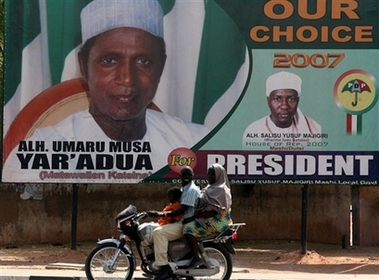
Yar 'Adua billboard and achaba: China Daily

Friday, March 30, 2007

From an Austin hotel: Ibrahim Sheme's blog and Ali Nuhu wins Best Upcoming Actor for role in Sitanda


After a long day of travel (during which I wrote a few things which I have not had a chance to edit for the blog), I arrived safely in Austin. The hotel has free wireless so I was able to check up on a few of my daily blogs (arrghh. can i not ever let myself take a break from this!?).


Ibrahim Sheme has uploaded an interview with the Hausa Star Ali Nuhu, who just won a Nollywood award for his role in Sitanda. I discovered Ibrahim Sheme's blog only a few days ago, but it's quickly becoming one of my favourites. Ibrahim Sheme is a fabulous bilingual writer (his blog is also bilingual), whose Hausa novel 'Yar Tsana blew me away. He is also the publisher of the Hausa FIM magazine and the brand new Frontline.

Saturday, March 24, 2007

Update on detained writer Friday John Abba

Here is an update from Dr. Wale Okediran (Association of Nigerian Authors National President) on the detained member of Kaduna ANA, Friday John Abba. I don't want to post the entire letter that Dr. Okediran posted to the Jos-ANA listserve without his permission, but here is the basic outline: On Wednesday March 21, an ANA team consisting of Dr. Okediran, as national ANA president, and officials of ANA Kaduna met with the Director of the Kaduna state SSS. The director confirmed that Friday John Abba has been in the custody of the SSS and claimed that FJA has been accused of being a part of a Niger Delta gun smuggling network. Under the auspices of "state security and terrorism," the SSS has "secured a special legal permit to keep FJA until investigations are over," meaning that he will "legally" be kept incommunicado without a public court charge until the SSS is "satisfied" with their investigation. (This sounds wretchedly like the rhetoric being used by the United States government over their bypassing of laws and abuse of suspected "terrorists.") His lawyer's application for bail was rejected. The Director of the SSS Kaduna "assured" the ANA representatives "that FJA is in good conditions and is not being tortured in any way." The ANA request to see and speak with FJA was "turned down" and they were told they would need to "formally apply for this through the National SSS Director in Abuja." ANA members as well as PEN Nigeria, and International, currently await for further updates on the situation.

For the original press release about FJA's arrest and the following discussion see here.

Tuesday, March 13, 2007

Off to the ALA conference and the detention of Kaduna writer Friday John Abba

I am off to the African Literature Association conference in West Virginia tomorrow, so I probably will be out of immediate contact until the end of the weekend. I'm traveling with several people from my department, and despite having never owned a car and having not driven in five years, I am signed on as a driver, so pray that I make it back to Blogville alive....! This time I'm not presenting, just hanging out and listening to papers, which will be refreshing. I will also be meeting Helon Habila! Yay!

After that brief preface, here is a more serious matter via the Jos-ANA listserve that I'm on that I have been wanting to blog on for a while, but I was waiting to find out more of the details. Over a month ago, the vice-chairman of the Kaduna chapter of the Association of Nigerian authors , Friday John Abba, went missing. After some investigation, it was found that he had been arrested by the SSS, and has been held in Abuja without any access to legal representation or to communication with his family. The Association of Nigerian Authors EXCO had a meeting scheduled with the national SSS director in Abuja today, and I will post an update when I hear what happened. In the meantime, here is a press release from Kaduna ANA.

And finally, here is a very interesting statement by Yar'Adua about his plans for Nigeria should he be elected.