Showing posts with label interview. Show all posts

Wednesday, January 02, 2008

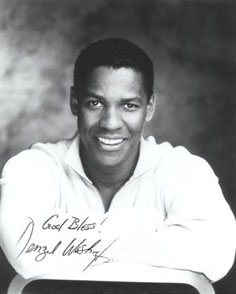
Denzel Washington tells it...


I was taking a little break from my prelims studying a few minutes ago to make some rice and gumbo to eat for the rest of the week, and I turned on NPR to listen to the news, while I was cooking. After the news, Fresh Air with Terry Gross came on. She was interviewing Denzel Washington about his new film The Great Debaters. You can listen to the interview here.


At one point in the interview (around time code 27:10) , she asks him about growing up with a father who was a Pentecostal pastor. Then she asked him if he still belonged to the church (Church of God in Christ [COGIC]), which he affirmed.

Terry Gross then says (around time code 29:00), "I'm wondering if that has even more meaning because you were so brought up in it... since your father---""
And he says, "No it has meaning because it has meaning. Because I believe in the scriptures. I'm a God fearing man who believes what he reads in the Bible, and that has meaning. The meaning that it has is the effect that it has on me, on him [his father] and has on thousands if not millions of other followers. It is our faith in God and our belief in these commandments and in the stories in the Bible...I've read the Bible a couple of times, and I'm working through it again.... I'm now in the book of Romans and listening to the examples and teachings of Paul. The perserverance and the faith that he had in spite of what he was up against... And I'm inspired by those teachings of Paul, of Luke, of all of the apostles, and the great leaders of the Old Testament, as well, obviously, Abraham, Moses..."

Later he says, (around 31:00) "You have to understand. Everything that I've done in my career, and hopefully in my life, is a reflection of my spiritual upbringing and cultivation. I'm not saying I've been an angel all my life. Heaven knows, I haven't.... But you learn. Because I had to go to church, I rebelled against the church, and probably many people out there have gone through that based on whatever negative experiences they may have had. But I can say this to you, whatever success I have, has been a direct result of my faith and the grace of God in my life. period. It's not hanging out with the right people, and it's not studying at some school, or training at some acting school. It's a gift from God, I recognize that. We all have it.

"So, the question is not what you have or what you're going to do with what you have, but recognizing that we all have that gift. It is the grace of God and the gift of God. For some it's acting. Some, it's radio. Whatever your ministry, as they say, is. Understand where it comes from and don't be ashamed of it. If you've had negative experiences in church, (because I'm talking about spirituality and not religion. You know, religion is where man gets ahold of it, and, Lord knows, that's where the problems begin), but if there is something still tugging at your heart, and you're not satisfied, and you feel that there is something there, there IS something there. And don't be ashamed or afraid to continue that search. It led me through all kinds of religions.... One of my favourite books is Siddhartha, you know Herman Hesse's Siddhartha, because it is the journey. And the journey has led me back to the Bible[....]"

Because I need to get back to my books, I won't transcribe the rest of the interview here, but it's a great listen. If you're interested, you can go to the website and listen to it.

What an unexpected blessing and encouragement in a long day of studying!
(And I'm planning to stay away from blogging for the next couple of weeks before my prelims, but I was so touched by this interview that I had to post.)
For the photo credit (Entertainment Weekly, 20-Dec-2002, DETAILS: Best of 2002 featuring Denzel Washington as Entertainer of the Year [photo by Norman Jean Roy]) and bio of the actor, see NNDB.

Thursday, November 22, 2007

The Heroism of Ordinary People: An Interview with Helon Habila


Thanksgiving day in America... a cornbread dressing in the tradition of my Louisiana grandmother is in the oven and a pumpkin pie is done and cooling on the counter. I'm going to my advisor's house later for dinner to celebrate with some other African students. My interview with Helon Habila was published this week. I am thankful:

This is the 1000 word (ie. gutted) version of an interview with Helon Habila I conducted via telephone last Tuesday before he left for his book tour in Nigeria. (The easy part was transcribing. I spent hours cutting it to get it to 1000 words... ughh...) The story of the interview itself is a longer one, which perhaps I will post about sometime, but Habila was one of the most gracious people I have met via telephone.... The following was published in Leadership this past Monday, 19 November 2007. Unfortunately, the link is no longer up, but this is how it appeared in the newspaper. (In an interesting aside, my dad met him today after the reading at the University of Jos.) Perhaps I'll post the entire interview on my other blog when I have a chance to edit it properly; it will be published in the journal Abiku early next year. But here is the short version:

"The Heroism of Ordinary People: An Interview with Helon Habila"

Award winning novelist Helon Habila grew up in Gombe State. After earning his BA in English at the University of Jos in 1995, he taught at the Federal Polytechnic, Bauchi. Moving to Lagos in 1999, he became the arts editor at the Vanguard and wrote a novel, published as Waiting for An Angel in 2002, which won the Caine Prize for African Fiction in 2001 and the Commonwealth Writers Prize in 2003. Habila has published stories, articles, and poems in journals world-wide and is currently a PhD candidate at the University of East Anglia. After a stint as the first Chinua Achebe fellow at Bard College in New York, Habila took a position at George Mason University where he teaches creative writing. He is in Nigeria from November 17 to November 24 to promote his second novel Measuring Time. In this interview on behalf of LEADERSHIP, he speaks with Talatu-Carmen [my real name used in the publication; i suppose i should stop this ridiculous attempt to protect my identity--pretty much everybody who reads this blog knows who I am], a PhD student at a university in the USA, about his writing.

Talatu-Carmen: I was wondering what your creative process is like. Where do your stories come from?

HABILA: I really cannot say exactly, but I am really inspired by books. Sometimes I write in reaction to books I have read. Then there is also my experience: Measuring Time has a lot of that—my experiences as a child growing up. There was a time when I realised that I wanted to write about my hometown. From that moment whatever I did I viewed it through the eyes of fiction, thinking of how to represent the people I met, the things I did, the places I saw. I was thinking of them as already a part of my book that I was going to write. I was going to write Measuring Time even before I started writing Waiting for an Angel.

In both of your novels the act of writing itself seems to take on a political significance. What, to you, is the political responsibility of the writer?

Well, quite a lot, especially as an African writer. I think there is that tradition which started from the first generation of African writers. They were writing against the whole colonial system, which was very repressive, very racist, very dictatorial. They actually used to have congresses where they would discuss the best way to write fiction in a way that would address the political issues of the day. Even before that, in traditional African society, from the folk tales, there’s always a kind of moral lesson, a kind of didacticism that is seen as an aesthetic part of that story. So politics more or less becomes an aesthetic in African fiction. There are no boundaries between what is purely political and what is art. Art becomes politics and politics becomes art. So I think people like me who find themselves in that tradition, and have that temperament, that awareness of what is going on, who feel that things shouldn’t be the way they are, have a duty to speak out. It is tradition and it’s also a matter of temperament, because there are definitely writers in Africa who don’t write about politics. They write art for art’s sake, or whatever you want to call it.

Could you say more about the influences of Hausa literature on your writing?

Definitely. I grew up reading the translation of One Thousand and One Nights in Hausa and the works of Abubakar Imam, Magana Jari Ce, Ruwan Bagaja, etc. So there is that magical or folkloric representation of reality, which is very different from pure realism. I was definitely influenced by that. And before that I was also influenced by folktales told to me by women in the compound. So, these Hausa books I discovered later were almost a continuation of that story tradition with the magical elements, spirit figures and things like that.

Both of your novels deal with history. In Measuring Time, the character Mamo wants to write a biographical history. Is this one of your own goals?

Definitely, I think so. Because so much that we have is fast fading away and being taken over by the modern, I see writing itself as cultural conservation. That is exactly what Mamo’s project is, conserving the history of people…, because they were misrepresented by the [missionary] Reverend Drinkwater. If you represent what has been misrepresented, you are putting the records right. And that is what history is supposed be. Taking moments of glory, and also ordinary moments—moments of humanity, of value to the community, and putting it down in books. It doesn’t have to be about generals, it doesn’t have to be about chiefs, it could be about ordinary people, their heroism. That is the whole point of the book, that lives should be celebrated, regardless of what office or what lack of office that person has.

Newton Aduaka, the winner of the Golden Yennenga Stallion at the FESPACO film festival, is making a film based on Waiting for an Angel. How involved have you been with this?

I’m not really involved. I’m just the author of the novel. I see film as being totally different from literature. They are both narrative art forms, but they have different ways of representing their story, their subject. I trust him as an artist. I think my novel is strong enough to stand on its own, even if the movie is a bit different in some of its portrayals.

Have you ever thought of writing a screenplay or becoming involved in film?

I really want to do that some day. Some people approached me to write a movie script. I started writing it and then it became a novel! I’m really enjoying the experience. I don’t know how far it’s going to go, but I’m definitely going to go into movies one of these days. To write, or even direct, if I have the chance. The movie industry is just incredible, and I think this is the moment to get involved.

All right, thank you so much.

Thank you, you’re welcome.

Photo credit: Helon Habila with Jeremiah Gyang and Ola Soyinka. Kudus to amazing middlebelt artists! From Naijablog